UPDATED 4 June 2025
What is the real nature of the CaPQ?
CaPQ is a Separatist Party
The Canadian Party of Quebec is an Anglo-separatist party that claims to “defend” Canadian unity. Founded in June of 2022, the CaPQ instead “supports” the complete dismantling of Canada mandated by the Supreme Court of Canada in 1998 regarding the “secession” of Quebec, and it does so in its party constitution.
What’s more, the CaPQ demands the partition of Quebec to form an “11th province” from the “English-speaking” regions, located mainly in the Montreal mega-city. The mega-city was built by the communist Parti Québécois in 2000 as one of 17 “administrative regions” designed as the foundations of a future federation of international city-states, each with its own parliament and governor.
The Parti Québécois is communist on the old Yugoslav model of Marshal Josip Broz Tito. Its real program — set out in a 1972 document entitled “Quand nous serons vraiment chez nous” — is called “industrial democracy”, workers’ control, participation, or workers’ self-management, implying socialist planning. It worked so well for Yugoslavia that, every year, Tito had to send 100,000 workers to find work in Europe.
As for the breakup of Canada, Trump’s timing is impeccable. He is perfectly attuned to the announcement of the CaPQ that Canada “must” prepare for a third referendum.
“Canadian Party of Quebec warns of another sovereignty referendum – July 26, 2024”
English translation. View on CPAC. Headline Politics / Canadian Party of Quebec Warns of Possible Referendum — July 26, 2024 / Colin Standish and Myrtis Fossey, co-leaders of the Canadian Party of Quebec, hold a news conference in Ottawa. The leaders are discussing a letter they sent to Canada’s political leaders demanding that the country prepare for a third referendum on Quebec independence. They are joined by their party’s Youth Critic Will Twolan. / Parti Québécois Leader Paul St-Pierre Plamondon has pledged to hold such a referendum if his party takes power in the next provincial election. (No interpretation)
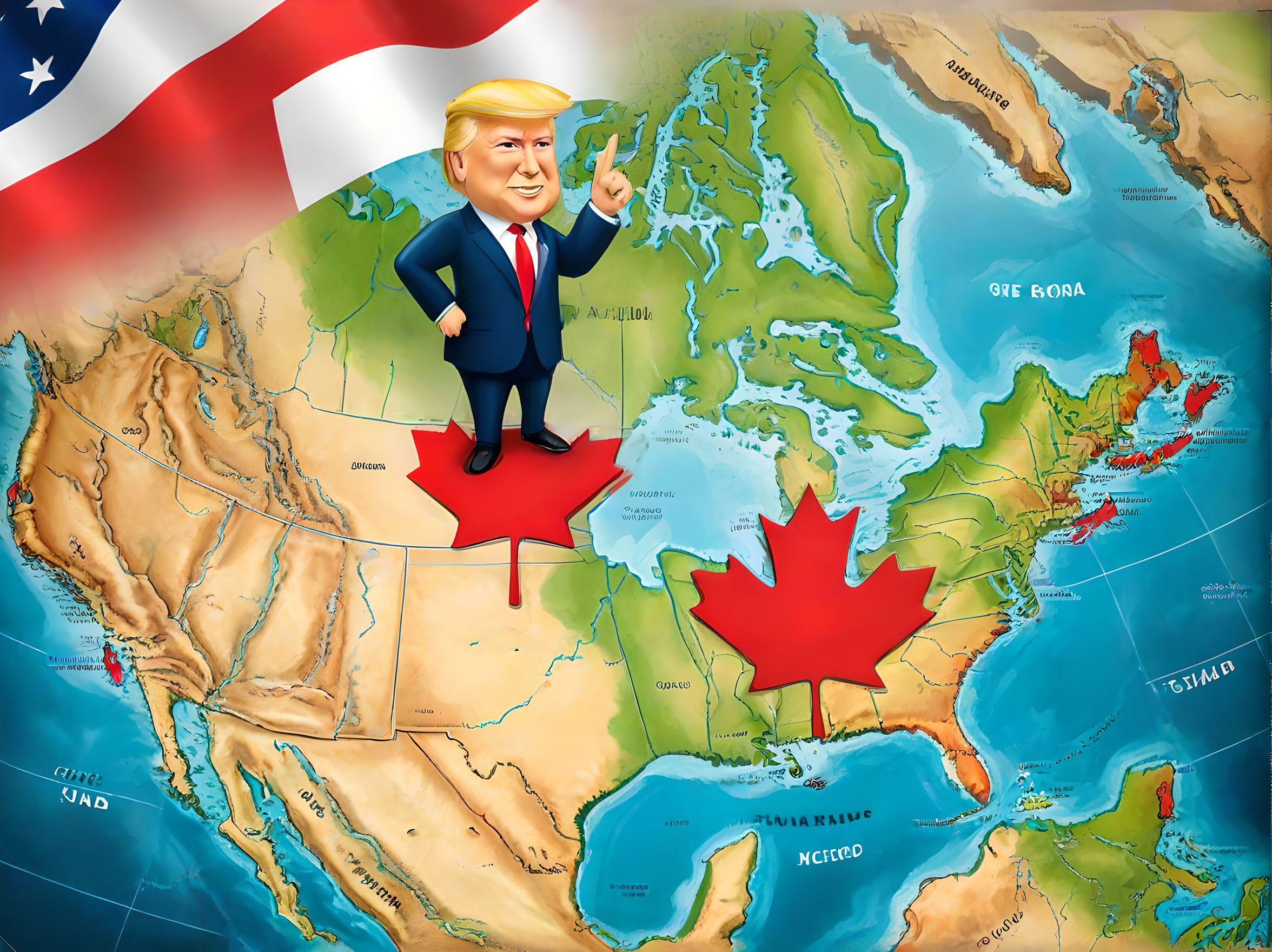
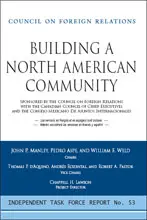
Once again, as with the referendums of 1980 and 1995, the plan is to break up in order to annex. But in this case, Canada’s remains — or so Trump hopes — will be attached to the North American Union, a continental region to include Canada, Mexico (and now Greenland and parts or all of Central America), and the USA. Pierre-Marc Johnson, a short-term leader of the Parti Québécois and Premier of Quebec was a member of the Task Force that produced a blueprint for merging North America published by the American Council on Foreign Relations (CFR). Johnson is now Chair of the Board of Directors of the Montreal Council on Foreign Relations.
Let’s clarify one point. The CFR is an Americanized version of the British-based Royal Institute of International Affairs (RIIA), which hands out the Rhodes Scholarships. The Parti Québécois was created by Lester Pearson’s federal government and Power Corporation of Canada, which distributes the Rhodes scholarships for Canada on behalf of the RIIA. René Lévesque didn’t create the Parti Québécois, the federal government and Power Corporation told him to. The dirty fingerprints, or rather tentacles, of this organization are all over the dismemberment of Canada and the construction of a North American and world union.
Who are the beneficiaries of the Rhodes scholarships? It’s a fifth column of elite intellectuals in every field, recruited and trained free of charge in exchange for subverting their home countries into the new globalist empire. As an example, the “patriation” of Canada’s constitution in 1982 was in point of legal fact a coup d’état on this country, led by a majority of Rhodes scholars at the Supreme Court of Canada. Wherever there is dirty work to be done, you can find a Rhodes Scholar.
CaPQ Foments Language Wars
The Parti canadien du Québec is fueled by language wars. Its camouflage is “rights” propaganda to divide and conquer, with anti-English laws passed by the Quebec government as the cattle prod to stimulate polarization. Like the PQ, which encourages French Canadians to separate from Canada because their French language is threatened, the CaPQ encourages English-speaking Quebecers to separate from Quebec because their English language is threatened. In fact, the French language in Quebec is not under threat; it’s the demographics of French Canadians that are under threat, because they’ve stopped having children and their population is shrinking, and therefore, so is the use of French. The solution is not to break up the country, but for French Canadians to have more children.
This is what the Marxists have done to the country. It’s racist for white people to exist, to want to exist, and be made aware of their impending disappearance in order to stop it.
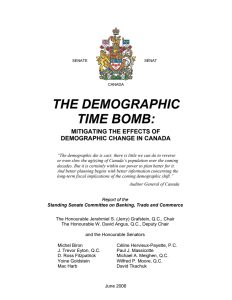
Canada’s Demographic Time Bomb
“Other than to situate us in the correct perspective, it will get us nowhere to affirm that the French-Canadian nation must probably disappear one day, and that the Canadian State itself will not last forever. Benda underscores that it is one of the grandeurs of Thucydides that he had been able to envision a world in which Athens was no more.”
“At the same time, and in a movement of retreat, English-Canadian nationalism must consent to change the image that it has made of Canada: if it wants to protect and incarnate these specific ethnic values, it must do so by means of carving out local and regional autonomies rather than by way of pan-Canadian sovereignty.”
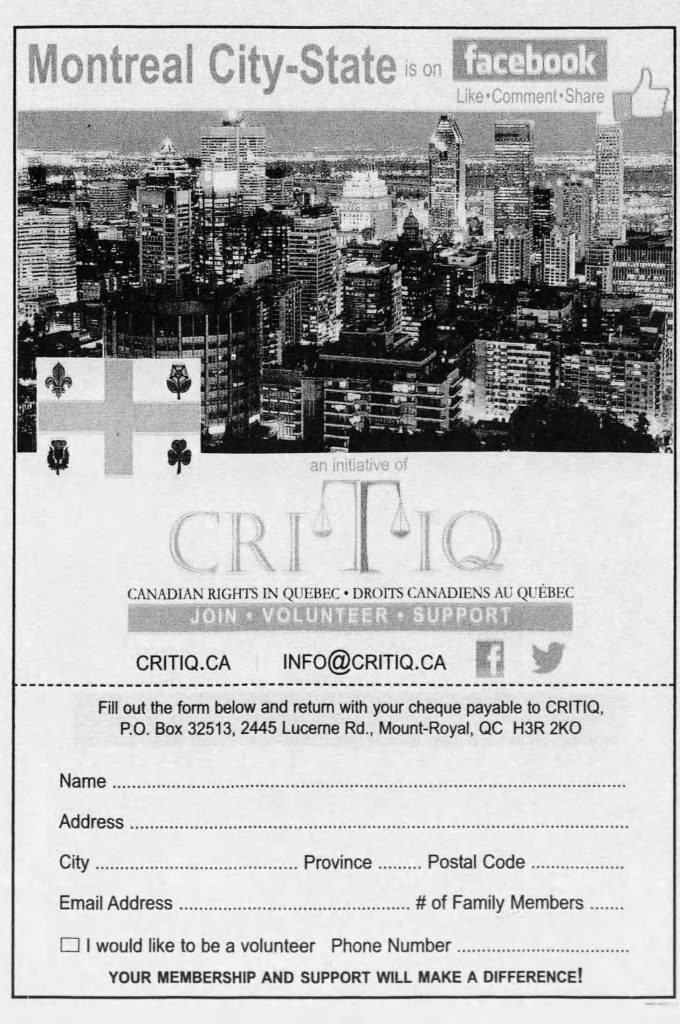
The ad above highlights the origin of the Canadian Party of Quebec: CRITIQ, a predominantly Jewish ethnic movement that advocates for the creation of city-states to replace Confederation. CRITIQ “lobbied” (euphemism for waging subversion) from 20 February 1996 to late 2012, and again from late 2012 to early 2022, to dismantle Canada into city-states. CRITIQ then mobilized useful idiot non-Jews to create a non-Jewish political party clone of CRITIQ (under Jewish control) to destroy Canada, the only way to ‘liberate’ the powers needed to implement the city-states.
In the climate of “threats to language”, the Canadian Party of Quebec works hard to throw “English-speaking” Canadians into conflict with French Canadians, in order to resolve this fabricated battle by tricking the Anglos into demanding “partition”. Partition is a pretext to create a legal framework for the city-state of Montreal. The city-state of Montreal would serve as a precedent for converting Quebec’s 16 other administrative regions to the same basis. We can expect a domino effect in other provinces, like Ontario, where preparations for the conversion to city-states began in 1998. We’ll discuss that another day.
The Fraud of CaPQ’s “National Unity”
The CaPQ was founded and recognized by the Director General of Quebec Elections in late June of 2022. On the front page of its website — scroll down — the CaPQ says in bold caps: “WHAT WE STAND FOR”. The bulleted answer below includes “national unity”. But this is a lie, as will be clear in a moment.
Summarizing up to now, the CaPQ “supports” an illegal, unconstitutional jurisdiction, in which, moreover, the judges of the SCC deliberately lied to pretend the Constitution is “silent” on the “ability” of a province to “secede”. Nor, in fact, has Quebec ever been trying to “secede” to become “independent”. It has been trying to blackmail all of Canada with a threat of its own independence, to force all of Canada to restructure itself into a “Canadian Union” using the EEC-EU system to replace Confederation.
The history, structure and language of the Constitution of 1867 is clear that the purpose of the Canadian quasi-federal system is to deny all “power” to dismantle and annex Canada to the USA.
Here’s a screenshot, and this link to the CaPQ’s original page in the Wayback Machine:
However, in its party constitution, the very opposite is true: the CaPQ is a hardline separatist party that supports the complete break-up of Canada. In its “Principle 2: Respecting the Integrity of the Canadian Constitution,” the CaPQ’s party constitution states:
“Regarding Canada’s territorial integrity, the Party supports the SCC’s Reference re Secession of Quebec judgment [sic], and calls for the repeal of Bill 99, An Act respecting the exercise of the fundamental rights and prerogatives of the Quebec people and the Quebec State.”
Here’s a screenshot, and a Wayback link to the original of the CaPQ party constitution.
First of all, the Supreme Court of Canada’s “Reference re Secession of Quebec” is not a “judgment” as the CaPQ proclaims. It is a non-binding, non-judicial opinion by judges sitting as mere “law officers”. This fact was admitted by the Judicial Committee of the Privy Council in England in 1912.1 (But the JCPC did not admit in 1912 that the SCC’s advisory jurisdiction was not constitutional, probably because the JCPC itself was not competent to deal with Canadian “opinions”, even though it had done so on numerous occasions). Since the Canadian “advisory” jurisdiction is unconstitutional, thus illegal, attempts have been made to legalize it, if only superficially, notably by Pierre Trudeau with his long defunct “Victoria Charter”, but always to no avail.
This begs the question: why should the CaPQ and its party members “support” a “judgment”? If the 1998 opinion were really a judgment — an enforceable judicial declaration of constitutional law — there would be no need to “support” it, but only to obey it. And yet we have this strange language of the CaPQ “supporting” the 1998 opinion, as if it needed reinforcing; as if it wasn’t really a “judgment”. And, indeed, it isn’t. This suggests that the CaPQ knows that the 1998 opinion is not a judgment, but wants to enforce it anyway, which we can only interpret as intent to commit treason.
The advisory — also called “reference” jurisdiction — has been exploited by more than one federal government to impose its will on the public by rigging the questions and replies. The public, misled to believe the opinions are judicial statements of law, therefore concede, unaware they are being manipulated. The Quebec “secession” opinion is a fraud, and the set of “patriation” files at provincial appellate courts, brought to “appeal” for a final opinion by the SCC, is another. Both were facilitated by the federal government’s abuse of illegal advisories.
Secondly, the CaPQ is so “separatist” that its co-leader, Myrtis Fossey, announced on camera a third Parti Québécois referendum by 2030, demanding that all of Canada “prepare” for it immediately. The CaPQ thus “supports” the Parti Québécois, and even undertakes to act as its agent and spokesperson. So why is one separatist party supporting another separatist party? Why not leave it to the PQ? Perhaps because the Anglophone “No” has to be dealt with, and that requires an “Anglo” separatist party? The CaPQ clearly supports a “Yes” vote in another referendum by the Parti Québécois because it “supports” the breakup mandated by the 1998 SCC opinion. Anglophones who join the CaPQ therefore join the “Yes” side, while being fooled into thinking they oppose it.
But the CaPQ’s “separatism” has an even more important purpose. The Parti Québécois has always intended to break up Canada into multi-ethnic city-states. As early as its first referendum in 1980, the PQ planned to “partition” Quebec into municipal administrative regions that would be “radically” revalued as new city-states. In 1976, the year the PQ seized power (perhaps in a rigged election, given the apparent rigging of the 1995 referendum for a “Yes” vote), PQ allies, posing as opponents, were ready to demand “partition” as the so-called “price” of Quebec independence. I’m referring to William F. Shaw, who in 1980 published a propaganda piece with his co-author Lionel Albert, introduced by Senator Eugene Forsey, demanding “partition” ….
But partition is not the “price” of Quebec independence, it’s the objective. Shaw, Alebrt and Forsey were controlled opposition who disguised the true PQ objective as Anglo retaliation to trick the Anglos into voting for it, thinking they were getting their own against French “separatism”. But, none of it has anything to do with French Quebec. The French and the “Anglos” are both being manipulated by bankers and big business, with help from our corrupt governments, to destroy Confederation for the globalists.
Thirdly, the SCC’s opinion on the “secession of Quebec” is designed to apply to all provinces and territories, not just Quebec. The SCC calls for mandatory “negotiations” to break up the country after a “yes” vote in another so-called Quebec “sovereignty” referendum.
However, these referendums are not about Quebec sovereignty. Quebec is being used to dismantle Canada into city-states in the North American region, better known as the North American Union or Community. The NAU, starting with the Canadian part, is intended to be merged with the European Union in a transatlantic handshake, as well as with the dismantled remnants of the United States and Mexico. This restructuring has always been a true goal of the Quebec “secession” movement and the Parti Québécois.
Another true goal of the PQ’s referendums has been to convert Canada to the new European system. In 1978, the ruling Parti Québécois produced a white paper anticipating the restructuring of Canada to adapt it to the EEC, with which Canada would then be merged. This was two years before the 1980 referendum.
Adding insult to injury, the CaPQ specifically plans to dismantle Quebec to form what it calls “The 11th Province”. This will be composed of what it describes as “the more ‘Canadian-minded’ regions of Quebec; but the main target market is “Anglos” in the English-speaking areas of the province. The term “Canadian-minded” gives non-English speakers a foot in the door. These could be recent immigrants, aboriginals, or even French Canadians.
Here’s a screenshot, and a Wayback link to the original:
To be clear, that page says:
“STEPS BEING TAKEN
The Canadian Party of Quebec has established a Preparatory Committee for the Creation of an Eleventh Province to look into the feasibility of partitioning Quebec into portions more Canadian-minded.”
However, what the “Canadian” in “Canadian-minded” means to the CaPQ is unclear, because language can be very subtle. It can also be abused, as I think we have learned by now, given the CaPQ’s use of the term “national unity” while “supporting” the break-up of the country.
Obviously, you cannot support both “national unity” and the dismantling of the country, and of Quebec. That tells me the CaPQ is up to something. And I think I know what that is.
1. Re References by Governor-General in Council (1910), 43 S.C.R. 536, aff’d [1912] A.C. 571